
Slay the Princess... Or Don't?
Games often present a simple contract to do simulated violence as the basis of gameplay. Do we ever spend enough time thinking about why that is?

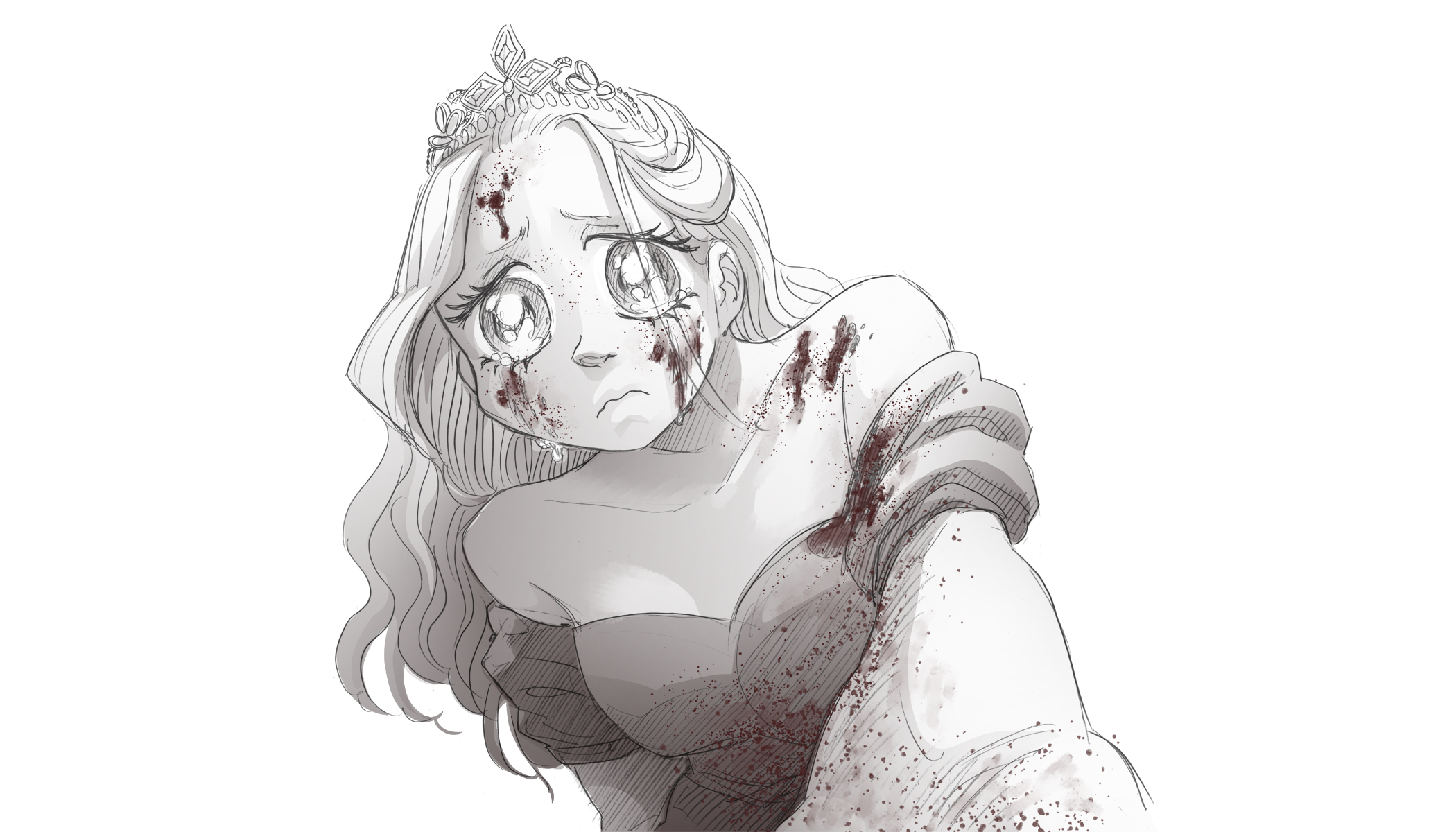
As I return to the land of the living after finally getting to a place in my current job where I feel like I can breathe again (don’t ask), I want to discuss a topic that has occupied my thoughts through many hours of hauling hundreds of books around every day:
Violence.
Generally speaking, when you sit down to enjoy a piece of interactive media, you want to progress your way through it. But what makes games different from, say, movies or pop songs, is that they put a number of arbitrary barriers in the way of that progression. A film, once started, more or less plays itself. When you click on an mp3, it will make its way to the end with no input on your part. But because a game demands that you do something to make it keep going—even if that’s something as simple clicking the mouse in a visual novel—that means the game presents to you a certain number of implicit expectations. It wants you to do something, even where the game never takes any time to say explicitly what those desires are. As someone who has designed a game or two, even the person making the game may not entirely know what their creation seems to want.
Thus, by demanding you, the player, do something, the game presents to you a kind of contract. Do this thing, solve this puzzle, race this car, slay this princ—err, monster, and you can move on to the next puzzle, the next race, the next murder. And like many real world contractual obligations, you are required to keep doing it over and over again. Show up to work, get paid. Keep showing up to work, keep getting paid. Keep shooting nameless “terrorists” in the head, and about 8 hours later, you and the boys will find yourselves in a bar throwing back pitchers of cheap beer, crying about how being a murder hobo is really about brotherhood and honor.
Pardon my cynicism. I’m genuinely not trying to “violence in video games” weirdo, but I do spend a lot of time thinking about why, given all the contracts games could make with their players, why do so many games—and more specifically so many of the most played and beloved—resort to the contract to perpetrate simulated violence? And why do a non-trivial number of those games demand violence while simultaneously bemoaning it?
Guilty Pleasures
I’m just as guilty of this as anyone. While working on Sympathetic Memories, I wanted to evoke a world in which visceral, brutal violence is a reality my characters live with day to day, while still making the choice to perpetrate it a real one. You don’t have to be a piece of shit to the other girls. You can find a path through the game’s story that relies more on empathy than force. At the same time, if I allow the player to do these despicable things, since, after all, I have to choose to build it into the game, I’m no better than a Call of Duty dev just because I happen to wring my hands over it. Some part of me—maybe a part I don’t want to think about too much—wants you to make those choices, to indulge in the cruelties of the world.
The Worst of All Possible Worlds has an excellent episode on Hotline Miami (paywalled, unfortunately) in which they make a salient point that so many games decrying their own violence never seem to come to: that simulated slaughter is fun. And the games where the gore and mayhem go well beyond what would even be physically possible often represent the most entertaining and memorable examples of their respective genres, be it a platformer like Super Meat Boy or light gun game like House of the Dead. I know when I was playing Rogue Trader, I always got a kick out of ridiculously gory some of the animations are. Your death cultist slashes at an Imperial Guardsman, and a huge gush of blood splatters halfway across the screen. It’s delightful.
You could make the point, as we do in the most recent Furidashi episode, that Slay the Princess isn’t really a game about violence, even though it does seem to meditate time and again on various violent acts the game demands you perpetrate. In fact, if you take the game at its word, then it’s a love story at its core. Perhaps not a typical love story, but one where progression is tied to empathy and understanding, not destruction. Because, time and again, the game renders your acts of violence completely moot. You go into the basement, you stab her, and eventually you find yourself back on the path in the woods where you first began.
Each time, your choice to do… whatever… to her results in a transformation of the woman in pretty dress you first encounter. Each transformation is, oddly, more a reflection of you than of her. Or, perhaps you could understand it as something working in tandem between you and her. There is a kind of attraction, in the most basic sense of being drawn to one another, caught in a loop.
Progression Through Repression Repetition
So, then, the contract here is very different from, say, Metal Slug. Violence usually moves things forward in games, but, ironically, only so long as you quickly forget about everything you’ve just done. In Metal Slug—or really any action game, but I like my goofy examples—you kill a bunch of dudes. A LOT of dudes. Just like in Contra, you kill a bunch of dudes. Or Ikari Warriors. Or whatever. The game moves forward insofar as you, the player, never really stop to take stock of just how many dudes you have erased from existence. Because there’s always the next obstacle. The next thing to kill or beat to a pulp. There’s simply no time to think through the ramifications of the actions you take. In some cases, like Gradius, you don’t really have a choice. The game automatically scrolls, pushing you forward into the next enemy.
Or old pal Freud can help us understand why this might be. While working with patients who had experienced severe emotional trauma, he identified in them a compulsion to repeat, what would later come to be encapsulated theoretically in the so-called repetition compulsion. This psychic impulse to repeat behaviors associated with a traumatic event came at the same time with an intense refusal to acknowledge the thoughts and feelings that event elicited. But this was fundamentally counter-productive for the patient, because they would continually experience the stress of the compelled behaviors without ever being able to get at the cause of their psychological turmoil.
The ordinary game contract, which forces its player to not really think about what they just did in order to keep moving forward, demands a kind of compulsion to repeat in the form of the gameplay loop. And like Freud’s patients, we persist in repeating these behaviors over and over without really thinking. In fact, the flow of a game typically goes more smoothly if you can engage with its mechanics without the interruption of your conscientious mind. But unlike Freud’s patients, we don’t necessarily experience this compulsion to repeat as distress, because it’s caused by the game’s mechanics, not by a traumatic episode whose unprocessed psychic damage lingers just below a person’s immediate awareness.
This is why conservative critiques of media violence so often fall flat, because they don’t really understand the underlying structure of how we experience it at the time and after the fact. It is possible, of course, that someone who has been assaulted would feel distress when literally participating in an assault in game, but that’s because they have experienced the reality of that violence, which the game media happens to tap into. It’s why some veterans have post traumatic episodes when fireworks go often, because an incredibly charged reaction results from being linked to some horrible that happened in their past.
Progression Through Integration
So, what happens in Slay the Princess becomes a kind of accidental meditation on violence, despite itself, because it’s messing with the mechanical structure of games that want you to repress the implications of what you do in order for the game to move forward. To do this, the game stages a very literally and visceral return of the repressed. The pairing of an initial treatment of the princess with her later transformation is a way of representing, as a game mechanic, what it would look like if the game loop’s typical repression weren’t permitted to happen. And it uses the same language of gameplay to do it.
Spoilers, but if you simply refuse to participate in the cycle of kill-and-re-kill, you will encounter a nascent entity that seems to be made up of different versions of the princess. She rather placidly implores you to repeat the cycle, in as many variations as you can, so that she might live out different versions of herself. Each of these she contemplates before integration, so it is, in many ways a kind of perversion of repression. Sure, that version of her will go away, but not before its full implications have been revealed. And by “full implications,” we mean both for the nascent entity as well as the player’s avatar. Reflection is a common theme in the game, and who she becomes at the very end—or fails to become—is an expression of the choices of the several gameplay loops you are compelled to undertake.
Thus, Slay the Princess is not fundamentally other to Metal Slug, but rather it plays with something that games typically don’t: explicit contemplation of what the player is tasked with doing. At the same time, the game goes out of its way not to condemn violence in the way kneejerk reactionaries did in the 1990s and many conservatives still do to this day. Violent interactions with the princess are reconceptualized as part of a greater whole, of the totality of experience. And on an aesthetic level, this non-condemnation can be quite jarring. The game is often incredibly gory, with the princess, in one version of events, literally gnawing off her own hand in order to escape the shackles.
It’s an arresting visual metaphor, if you stop to think about it, one in which a grossly violent act is made to be synonymous with the pursuit of freedom. This version of the princess struggles so forcefully to be free, to be part of the greater whole, that she’s willing to sacrifice her own hand to achieve it. And in another scenario, the game seems to criticize passivity. If you unflinchingly act to save the princess, in the stereotypical way that games do, on the repetition, you get a version of the princess whose art style becomes more and more simplistic, at point resembling little more than a child’s first drawing. The implication seems clear: total nonviolence isn’t necessarily an answer either. Sometimes aggressive, violent struggle is warranted.
Love?
To sum up—and maybe avoid the very topical, real world implications of necessary struggle—it’s worth going back and taking the game’s stated claim, in the opening text, that it is fundamentally about love. Not a cloying love, which seems to be what that art degradation above is getting at, but something difficult, complex, that doesn’t shy away from the nastier side of our desires. How we indulge them, how we resist them, how we might feel ambivalent about taking pleasure in the grotesque.
Not to get too sappy here on a game design blog, but love is just as much about understanding as it is about desire. It’s both. When you love someone, you want them in your life, but that means having to take them as they are and not always try to mold them to your expectations the way the game initially expects you to just go into the cabin and kill her. Imposing your whims means, in the game as much as in love, having that imposition turned back onto you. If you fight her, she fights back. You become overly submissive, she becomes a dom. If you’re indecisive, the princess comes back as a nightmare to haunt you. In each instance, the interaction is a metaphor for how love can play, in its many splendored and gruesome ways.
It could be said then that while Slay the Princess isn’t entirely about violence, it does use violent acts as a way to break through the natural repression of ordinary gameplay. You have to sit with the ramifications of what you do, so that, hopefully, in the end, you kind find a greater peace. This is, to my mind, what makes the game so captivating. It’s not just a “thinking person’s game,” but a game that wants to break a cycle, even as it deploys it over and over again.